Category Archives: Uncategorized

November 16th, 2017

The colour palette is muted, but rich; on the trees, rust, gold and khaki of dying leaves echo on a larger scale the lichen and moss covering their trunks. On the Lydden Downs the chalkland flowers are almost gone, apart from a sudden burst of yellow from a lone tormentil. A splash of deep red rosehips, the copper light shed by the setting sun. Otherwise the spectrum is constrained. No, not constrained, rather compressed; all variation of colour and hue is there, but within a shorter range between light and dark; a more subtle display after the summer’s exuberant excess, but no less intense.

Alf and I follow the contour of the coombe, my sight always on the setting sun, his nose always on the trail of something; he experiences the world in a different way to me, but he also loves being here, in this moment. We follow the farm track under the A2 towards Temple Farm. On the high chalk plateau everything is still, as if the world is taking stock before plunging in to winter. I can just make out to the north-east, in the fading light, the cliffs of Thanet, and above them, in many shades of grey, are layers of cloud. To the south-west the sun is now shining through a providential break in the overcast, and The Light is creating magic. As we walk across a field of young cabbages, our path delineated by the paler track of trodden crop, the Georgian facade of Singledge Farmhouse (its stock brick painted with cream wash) suddenly glows gently, almost spectrally, in the twilight’s last gleaming.

Returning past Temple Farm, facing west, even the artics passing along the A2 assume a strange sort of beauty, back lit by the dying day. The traffic noise doesn’t disturb my reverie; it seems like the echo of another world, an unimportant one, an unreal one. What’s real is here, now, this moment; Alf always has lived in the moment, being a dog and thus blessed with more wisdom than mere humans, but this is something I am only just recognising as fact after sixty-two years struggling to come to terms with life.

Someone once said to me, after reading some pieces I had written, that the problem with what I wrote was that there was no narrative, no story. That’s certainly true; I have no talent for constructing a plot or creating characters. But then, neither does that have any interest for me; the world around me has all the plot, the drama, the heartache, the joy I could ever hope to experience. The endless river, the sun rising and setting, autumn following summer and spring following winter; the endless cycle of procreation and birth and life and sickness and death, of lightdarklightdarklightdark, for ever and ever.

I haven’t written for a long, long time, and I’m a bit rusty, but this is the moment I want to write about; not the past, or the future, or an invented story. None of these are real, only this moment, then the next moment, then the next. There is no story, it’s all now.


Water flowing underground, 30th July, 2012

Walking through a wheat field in Wiltshire two weeks after visiting a damp Dorset, and the crop here is drying, at last. The rain has lessened in the interval (if not ceased entirely) and this evening is warm and bright. Alf and I are camping in the VeeDub, at a campsite near to Stonehenge, and we are hurrying to the Boot Inn at Berwick St James to assuage thirst and hunger after a long drive. The evening is not only warm and bright, it is perfectly, heartbreakingly glorious, the sort of evening we English think our Summer evenings should be, but rarely are. The perfection continues as we enter the small inn, me sweating and Alf panting with the sudden heat inside; ‘Is it OK to bring my dog in?’ I ask. ‘Absolutely’ the barlady says with a smile, tactfully ignoring the fact that in my eagerness to get in I hadn’t noticed the several dogs already milling around inside, rendering my question pointless, if not idiotic. People smile at Alf as he says hello to fellow canines; ‘Oh, how sweeeet; what sort is he?’. I order a pint of Wadworths 6X and a plate of sausage and mash, then we go outside to sit at a table in the evening sunlight. The beer is perfect, possibly the best pint of 6X I’ve tasted. The other customers sitting outside are perfectly friendly (mainly down to Alf, it must be said; everyone we meet wants to know about him).

The temperature is also perfect now, as Sun slips slowly down behind the row of perfectly English thatched and beamed cottages on the other side of the village street. The occasional tractor roars up or down the road; farmers will be working all hours to gather in the harvest now that the weather is finally giving some quarter. Our dinner appears; two large locally produced pork sausages for me, one for Alf. It is perfectly delicious, my taste buds tingling at the taste of fresh, properly produced meat (usually vegetarian at home, I love to eat proper meat and fish when I get the chance). The second pint of 6X is as good as the first, and for the first time in, well, a very long time, I feel content, free of sorrow, free of worry. I know this will only last for this stolen weekend, but it will have to do.

With the problems of hunger and thirst solved, and my head gently buzzing from two pints of decent beer, it seems a good idea to make the most of this magic evening and walk back to the camper the long way round. So we stroll southwards out of the village, to where the road bends sharp left to cross the little River Till. There is a junction with a track running along the west bank of the river here, and a small pool has formed on the downstream side of the bridge.

Alf paddles in, as usual; the water is running fast under the bridge, but this shallow pool is calm and I let him enjoy his immersion. Now turning east with the road, and then carrying on straight where the road curves south again we start to climb gently along a wide track towards Druids Head Wood on the ridge ahead. The track follows the subtle curves of strip lynchets on the hillside; they in turn follow the contours of the coombe as it melds into the main flow of the ridge. At a crossing of ways, between the small wood and the farm, we turn due north along a hard metalled track following the ridge.

The temperature now is cooler, but the air is laden with the memory of warmth, and the light is still golden. It diminishes and changes, as we walk fast along the track, to copper, then bronze and finally to molten iron as Sun starts to drip over the edge of the world. Beech clumps punctuating the downs to the west are ships anchored on the chalky swell of the Plain in the slow darkness. At the next intersection of tracks an owl hoots from a patch of woodland. We are now heading to meet the main road to the West, the old Harroway, so at the next crossways, between another farm and another small wood (this landscape has a quality of rhythmic repetition that I like) we turn south through fields, rapeseed pods whispering dryly, and down into the village of Winterbourne Stoke. Just past the church a gate opens on to a field containing four huge sycamores; a causeway passes them and runs south back to Berwick by the river, but we turn right to cross it by a footbridge (the plash of rising fish seeming loud in the cool air) and back to the campsite.

It’s good to be back on Salisbury Plain after a gap of several years and I feel excitement at the thought of exploring further tomorrow. I like the ominous edge the landscape possesses; the juxtaposition of the serene curves of the chalk bedrock and the quiet beauty of the valley villages with the ugly, angular evidence of military occupation and intensive farming that confronts you at intervals. It is a landscape that can seem very bleak, even under full sunlight; try walking the track from Gore Cross through the ghost village of Imber to Warminster when the military next open up the ranges and you will know what I mean. However, the open nature of the landscape and its sometimes disconcerting emptiness also gives rise to its ability to calm the mind, to let it free to contemplate higher matters. Even without the litter of monuments to the ancient dead, the Plain would still be a place where the mind regards eternity. Alf and I sleep well.

In the morning, Alf is impatient to be out and about, so in early sunlight we walk back through Winterbourne Stoke and cross the Harroway (not yet, this early, transformed into its screaming, psychotic alter-ego, the A303) to follow the track towards Shrewton. Willow pollards mark the course of the River Till as it runs down from Salisbury Plain. The ‘Winterbourne’ in the village name tells you the truth about this stream, which is not technically a river, nor originally named Till. It was only given this name after a Victorian map maker decided that the stream simply called locally ‘Winterbourne’ must sensibly, as it rose near the village of Tilshead, have given its name to this place, the Head of the Till; an understandable leap of logic, as this is not-uncommon source of place naming (for example, Exmouth is actually a place situated at the mouth of, and so named after, the river Exe), but unfortunately in this case Tilshead is a derivation of the Early English ‘Theodwulf’s hide’. Pedantry aside, it is a warm, sunny morning in late July, and normally at this time of year the stream would be non-existent, its course marked only by a snake of lusher greenery squirming through the fields, for the Till is a type of watercourse found in chalk and some limestone areas known as a winterbourne. These streams, as the name pretty well explains, only normally run in winter and early spring, after the autumn and winter rains have raised the water table in the chalk bedrock. But, as this past year’s weather patterns have been strangely inverted (an unusually dry autumn and winter followed by the wettest spring and summer for a century), many chalk streams had been dry right through the last winter, only to gush forth from May onwards as week on week of torrential rainfall soaked into the aquifers.

So the Till on this beautiful, soon to be hot, morning is full, glinting between the pollards, and in fact actually overflowing its shallow bed and flooding some of the fields it runs through. The view is from the top of one of an assemblage of barrows (prehistoric burial mounds) erected approximately 3500 years ago on the lower slope of High Down, west of the upper reaches of the Till (the back-formed name is still useful to distinguish it from the several other winterbournes in this chalk country). Surrounding the barrows is a much later, probably medieval, earth bank called The Coniger; ‘coney’ is an old word for rabbit, and the name indicates the barrows were utilised as warrens later in their career. True to his terrier lineage, Alf chases the coneys around the Coniger, but never catches one. About a mile north-west, on the other side of the valley, is Fore Down, with its own collection of barrows looking down over the water. Directly west, about two miles just over the crest of the distant ridge, is the Winterbourne Stoke Crossroads group; a Neolithic long barrow, aligned on the midwinter sunset, at the head of a train of large Bronze Age round barrows taking the same alignment, at the crossing of east-to-west and north-to-south trackways (still important in their present-day tarmac disguises). And a mile further west is Stonehenge, invisible from here but the magnetic centre of the enormous landscape composition in chalk, sky and water that is Salisbury Plain.

Proximity to water seems to be a factor in the siting of these places; sources of good water would obviously be extremely important to early settlers in this high-and-dry landscape. The chalk is an extremely efficient filter and storage system, and springs flowing from it supply crystal clear, safely drinkable water. Some would be subject to seasonal interruptions in flow (the winterbournes), so watercourses with a year-round flow would be even more valuable, and revered as givers of life. So, echoing on a larger scale these small barrow groups overlooking the tiny Till/Winterbourne, important sites like the Stonehenge and Avebury complexes are connected to, respectively, the Avon and Kennet, both permanently flowing rivers.

But all these sites, large and small, are also linked with the sky and the underworld, acting as a conduit between these two states beyond life, and mortal life, as represented by earth and water. In describing these places it’s difficult not to use phrases like ‘ceremonial landscape’ or ‘ancient religion’; from this time, looking back to that time without the help of written history, we can have no certain idea of the impulses and states of mind that caused people to build places like Stonehenge or Avebury or the dense scattering of barrows (singly, in groups or alignments) and other, even more enigmatic, earthworks over the chalk hills of Southern England. However, when you actually stand at one of these places an atmosphere of sanctity still seems to cling to them (even, just, to poor, mistreated Stonehenge with its bleak car park, hot-dog stands and high-security fencing).

I think that, probably, those people in the past had the same need for spiritual comfort as we do, the same desire to make sense of, and impose order on, a harsh and random Nature. And so they raised the earth and stones under their feet to create beautiful monuments to their dead, to mark and stand sentry over water sources, to follow the spinning courses of seasons and heavenly bodies. These monuments seem to have been created following certain principles involving lines of sight, a harmonious relationship with the surrounding landscape, relationships to other monuments and links to water sources; what believers in the Age of Aquarius would call geomancy, and the Chinese refer to as feng-shui. There’s an awful lot of drivel spouted by neo-pagans about a posited pre-Christian, nature-worshipping, female-centric ‘ancient religion’, most of it as laughable as the idiocies of Christianity, Islam and the other fairy tales we insist on creating for ourselves; ley lines, standing stone phalli penetrating blind springs (water flowing underground), nodes of geomantic energy, a Neolithic National Grid of spiritual power with Glastonbury Tor, Avebury and Stonehenge as immense generators. It’s all too laughably self-serving.

But, but…. and but (and this would be my own personal fairy tale, not to be imposed on anyone else by violence or missionary zeal), when I walk an ancient track from one ancient monument to another, and see how our forefathers worked with the landscape they lived in to create something beautiful that seems to say something about our position in creation and so gave that landscape a spiritual dimension that is felt in the heart as much as seen by the eyes, I believe that the landscape, the earth walked upon, is numinous and contains a spirit of place that our own tiny spirits respond to. I might even be tempted to call this spirit ‘God’, except that what I don’t believe is that this spirit or force regards us at all, other than as simply another component of the natural world; it probably would not have intelligence, as we would understand that term, and it certainly wouldn’t be there to ‘look after’ us, however many stones we raised or prayers we uttered. The spirit is rock, and wind, and seasons slowly cycling, and slow erosion, and tectonic movement, and water flowing underground, same as it ever was. Its utter disregard of me, and all of us, is immensely beautiful, and immensely comforting in its boundless creativity. Maybe James Lovelock’s concept of Gaia is nearer the mark.

So now it’s out in the open; I’m an unreconstructed hippy, a neo-pagan flower-child, a scion of the New Age of Atlantis. Whatever, that sense of deep spiritual contact with a semi-sentient landscape is why I walk; every step is a pilgrimage following thousand of others, mixing a few of my atoms with a few remaining from my predecessors, and with those of the earth under my feet. Eventually all my atoms will become part of the landscape, like one of the billions of tiny shellfish whose deaths over aeons slowly created the chalk that my feet feel so at home on.

Water falling from above, 30th July, 2012

High summer in rural Dorset and the sound and smell and feel of water is everywhere. Driving to Cerne Abbas we descend the steep lane from Piddletrenthide, swept downhill from the ridge like a canoe shooting rapids. Arrived, and hurriedly unloading the car outside the guest house (unsuccessfully trying to dodge huge raindrops), the culverted stream thunders under the pavement; water bubbles through cobblestones from the flooded cellar of the New Inn opposite.

Taking Alf for a short post-travel leg-stretch proves foolish; as soon as we set foot on unpaved paths we sink in ooze, liquid mud splashing with every step. Vegetation, in rampant rain-fuelled overgrowth, slaps against us, soaking those parts not yet wet as a result of the pouring rain and the waterlogged soil. We trudge a few hundred yards along the path below the Giant’s feet, then admit defeat and retreat back to the guest house to remove sopping clothes, and to towel a drenched dog.

Later, after dinner at the sodden-but-still-open New Inn, in the gloaming, dried-out dog and I walk again around the village. The rain has reduced to a gentle drizzle, but the sound of the several streams joining here to form the River Cerne still fills the air, water rushing, trickling, dripping. Heavy clouds press down on the surrounding hills, roofing over the valley and sealing in the sound. It feels safe here; at any time this valley has a quality of time in suspension, an atmosphere of solitude and peace, but the huge, soft grey duvet slowly settling down intensifies this feeling. The air smells like the sea.

In the morning, rain ceased and sun glowing, we go to St Augustine’s Well in the churchyard, walking first along Long Lane out of the village, then back round through spongy fields. The spring here is the reason Cerne Abbas exists (probably has existed in some form for thousands of years) as a settlement; rainwater percolating through the chalk hills to the north meets a water-resistant layer of clay, to escape through a small fault in the chalk as this beautiful upwell of clear water. In a normal late June the well water would normally be still and stagnant, low in its basin, but this sodden summer it is overflowing and running fast, clear and cold, perfectly filtered by miles of chalk and perfectly drinkable. This spring of pure water encouraged our ancestors to settle by it, and they very likely revered it as a source of life; it still bears a mythology of healing and fertility (many of the sites of ancient reverence in the chalklands of southern England were linked to sources of water; for example, the Avebury complex to the rising of the River Kennet, or Poor Lot barrow cemetery and the Nine Stones circle in South Dorset to the springs feeding the South Winterbourne). In 987 CE, an abbey was founded on this already ancient sacred site; the bright early morning sun brings the humps and holes that are, mostly, all that remains of the abbey into sharp relief as Alf and I tramp wetly through the just-mown grass, glistening with its freight of moisture. The green curve of Giant Hill soars above the trees, but He cannot be seen. The air is viscous with the past.

Rain unexpectedly holds off for the rest of the day, and in the late afternoon, while Heidi rests, my right-hand-dog and I set off on another exploration, passing through the abbey ruins again and this time taking the path that ascends, at a shallow angle, the south-eastern flank of Giant Hill (really a mile-long promontory thrust out at ninety degrees from the main chalk ridge ahead of us). The evening is gently warm, breezy; pale sun illuminates the opposite wall of Yelcombe Bottom at intervals as we climb the hawthorn-bordered track. Patches of light from a celestial mirror-ball, texture of sheep-trods suddenly thrown in relief. At the top, we contour round the summit of the hill to reach the western side, passing more humps and holes, these much older; Iron Age people settled on this high, dry, easily defended belvedere. Maybe they also garnered some comfort from the fearsome presence of the Giant a few yards away, but invisible on the steep nose of the promontory. I like to think of them using the path we had just ascended to fetch water from the sacred spring down below. The air is soft and clear, beech clumps on the Sydling ridge sharp and looming near.

A gate opens on to a field of wheat, where some Moses has cleft a path between the stalks, through a sea that shimmers silky grey-and-green as the wind stirs it to waves. It should be glowing dull gold by now, the plump ears fed by rain in spring drying and bleaching in the heat of summer. A surfeit of rain and a shortfall of sun means that the breeze soughs through plants swollen with moisture, but still green behind the ears. Water equals life, but sometimes there is too much, even on these swiftly-draining chalk hills. Farmers pray for dry weather to harvest. They can do little else; for all the technological and chemical help available to them they are as powerless in the face of weather as the first Neolithic farmers on these hills, scratching the thin topsoil to sow emmer wheat and trusting to the offerings they had made to the land to guarantee a harvest, as the spring gushed below. We push on, parting the waves, towards the dark clump of beeches and oaks marking the old ridge track hugging the horizon ahead, but before reaching it turn down left, through the wooded hillside towards Minterne Parva, with, above it, Minterne House cradled near the head of the Cerne valley, the twin heights of Dogbury Hill and High Stoy looming, mysterious in green, on either side. Between them, the col at Dogbury Gate affords a Palmeresque vision of the Blackmore Vale beyond, pale gold in sudden sunlight.

Nestled back down in the valley, we walk along the lane from Minterne Parva and reach the river again, a smaller stream here, near to its beginnings. Alf paddles and drinks noisily, as is his custom, looking up at me with water dribbling from the fur on his muzzle as if to say ‘That’s better…’. I just enjoy the sound of the Cerne bubbling through the little culvert under the lane, under the trees, the endlessly dancing facets flashing the shaded sunlight in my eyes. The evening is warm, pale copper and peaceful under the sun. Thirsts slaked, we walk on, under trees, over the main road as the evening bus to Sherborne burbles past (not an earthy brown Bedford, sadly; Bere Regis & District buses only run now in memory).

Across the road the trees overhead change from oak to beech, forming woodland on the slope of High Cank to our left, and bordering the park of Up Cerne Manor to our right (cricketers practising on the sward backlit by evening sun, almost a caricature of essential Englishness). My footfalls on the tarmac fall into a syncopated rhythm with the regular bass of the beeches passing by as we descend the hill; Alf’s freeform scampering (up, down, across, back to where he just started) could be Jeff Moris Tepper soloing over the top. It rocks.

We do the floppy boot stomp, down into the ground, and find ourselves in the valley of the Cerne’s tributary, at Upcerne (or Up Cerne; no one seems to mind which). We halt at the centre (if it’s possible for a place so small to have a centre), where the stream crosses the lane and a smaller lane forks off northwards to become a track and then a path gradually ascending to Telegraph Hill on the great chalk ridge that falls into Blackmore Vale. The stream is spreading across the road from its shallow bed. We stand by Not The Bus Shelter to take water again (Alf from the stream, me from my flask) and the thirty years since the last bus disappear. The water still flows, same as it ever was. This place is still quiet, after all those years, and instils quietness in me. Quietness is not an absence of sound, it is water flowing, leaves rustling, birds talking; it is sounds that soothe the soul. Noise is any sound, however low in volume, that destroys the soul; it is the hungry growl of traffic in the distance, the inane beeping of computers, the emotionally and intellectually bankrupt drivelling of daytime TV. I want to enter further in to the quietness, up the valley, but we are already overdue for supper, so we will return tomorrow.

In the morning, we retrace the straight path through the wheat and pass the squat, seemingly organic, bulk of Up Cerne Manor, lichen-grey against chalkhill-green. The rain has returned, but only as showers out of the grey above, refreshing rather than drenching. Taking the left fork we walk beside the stream running fast and clear in its channel, spreading still over the surface of the lane. Vegetation drifts in the crystal water, freshest-possible green; seemingly Ophelia could drift past at any moment. The clouds lower, lambent with concealed sunlight as we pass Great Pond, the source of the stream; but the quietness issues from further ahead, so we continue beyond the tarmac onto rutted chalk as the way ascends gently. Dark woods line the crest of the eastward ridge; that to the west is bare. We progress along the track towards the head of the valley, also wooded, as the two walls converge.

A hare stands in the way ahead, only moving slightly into the field beside as we pass him, slowly now. Alf doesn’t chase the elfin creature, he seems aware of its magical significance. I look around after we pass and the hare is swallowed in the crop. The path takes a right hand curve to approach the valley’s end by a shallow spiral. A buzzard glides over into the woods on the ridge ahead. The path empties into an open field sloping at first gently, then steeply, up towards the ridge. I feel a tension, a slight buzzing in the head, in this natural amphitheatre, a not-unpleasant claustrophobia and a sense of immanence; the tension breaks as a deer runs diagonally up the hillside into the woods, following the buzzard’s path. This landscape retains the memory of water in its shape, as well as a vast reservoir within its physical mass; glacial meltwater seems to flow over me, scouring the valley’s smooth shape as I watch. Turning, I look back down the valley and the claustrophobia disappears to be replaced by a sense of freedom. We start to march fast back towards Cerne Abbas, light of foot and paw; I have a feeling of being pushed from behind by a vast wave, a hydraulic ram filling the trough of the valley, and of being cooled by water falling from above, gently.

The land teaches us of life, but we no longer understand its language.

Waiting, 14th May 2012

The sun is warm. Facing south, on the north pavement of a wide suburban street, the light is blinding as it reflects from the just-unseen sea, probably less than a mile away. The street is quiet and empty, no people walking, no cars driving past. I’m not sure how I got here, wherever ‘here’ is. There is a bus stop where I stand, a precast concrete pole, hexagonal in section, bearing at its top a square enamelled metal flag that says ‘SOUTHDOWN REQUEST STOP’, set out in three lines of equal length. I seem to have been here a little while; the body is cooling now after the exertion of walking from wherever I came.

The sun is warm and I am sleepy. I turn slowly to clear my head, and to try and work out where I am, where this quiet street, stretching almost to either horizon, might be. Familiar, but still can’t place it exactly; most likely Sussex, could be Littlehampton or Worthing, Upper Portslade or Saltdean, maybe Seaford. The houses are semi-detached, built probably in the nineteen-thirties, some rendered and painted white, some in brick, most with curved bay windows, all with shallow-pitched hipped tile roofs. Their clean lines of their architecture and the endless street impart a sense of calmness and spaciousness to the mind, the repetition of roofline and window a mantra. Above and behind the roofs rise smooth green hills; they, like the street, appear empty of life, but a sense of ancient presence flows from them like a cool breeze.

The sun is warm and my mind is slowing. Waiting for a bus, I suppose, but the familiar apple-green-and-cream is nowhere to be seen, nor can the subdued clatter of a Leyland diesel engine be heard approaching. Must be a Sunday, so quiet; can’t remember the times of the Sunday buses. But it doesn’t matter; a blanket of calm is descending as I stand in the sun, baking in the light pouring from sky and sea and reflecting from the windows and white walls behind. The sweat is drying on my brow; I can feel the skin contracting and if I raise fingers to my forehead there is a thin crust of exuded salts. My body is giving off a hot, tight odour, not unpleasant, mummifying in the hot air, becoming dry and papery, concentrating the essence.

The sun is warm and I feel tired, as if I don’t want to go any further; but this quiet, empty place is fine to rest for the moment. It occurs to me that the last Southdown bus ran many years ago, when I was still young. How old am I, exactly; how long on this earth, in this place? I close my eyes and try to recall. The sunlight renders eyelids translucent and the hot orange-red light saturates sight, returning me to remembered days laying on warm grass. Memory slips backwards, further and further: staring into Sophie’s eyes, held oh-so-willing captive in her heartbreaking beauty; being hypnotised by the sway of Elizabeth’s hips as she walks in front of me; Yvonne smiling at me in the pub as I try to pluck up the courage to talk to her; picnics with Mum on Crowborough Common; Sara aged five running, crying, along the aisle of the church where Michael was married; and near the beginning, a grainy image (as if from a decomposing negative) of trees in the garden at Beauvaris waving in the wind as I gaze up from my pram.

The sun is warm, still, although the light is golden now as it slopes in from a shallow angle. Sleep must have stolen over me, in the train of reverie, as I stood here waiting for the bus that never appeared. Out of the corner of my eye I catch flashes of movement, so quick as to make me wonder whether imagination is creating them; subliminal blurs that might be figures or vehicles or passing lives. My own life appears no longer to be passing; it is hanging in stasis, like that weightless moment we all have as a child, as the swing reaches the furthest point of its trajectory and we hang, for a tiny eternity, before rushing back to the beginning of the arc.

The sun is red, up here at the apogee of this arc, and I don’t seem to be aware of temperature, looking down on the smooth chalk hills behind Brighton. The street I where I was standing is no longer there, no Upper Portslade or Hangleton or Mile Oak spreading over the slopes of the Downs, and the coastline is at least a mile further out than I remember. The town is just a village now, fishing boats dotted around a small circular bay. I seem to descend, slowly at first, and even that small habitation is replaced by the trees growing on the lower slopes of the Downs. On the ridge, burial mounds stand white and tall, free of the vegetation of three thousand years. Wood smoke drifts from settlements below the crest. I sink to the sweet turf; subsumed in this landscape where I was born. I am not I any more, just an atom, a part of the whole; no pain, no desire, just joy at being home.

In my place, at last.

Walking in the sky, 13th February 2012

Autosave-File vom d-lab2/3 der AgfaPhoto GmbH

Sitting by the shingle with a coffee and a Danish (and a piece of bread pudding) before climbing up on to Seaford Head the beauty of this February day is breathtaking. The sea is calm, grey-blue, fading into sky at the edge of sight. Gulls careen through the clear air and holler their freedom. To the right is the grey bulk of a Martello tower, and stretching out behind it the seafront villas and apartments of Seaford, the flattering light of this dazzling day masking the shabbiness of their sometimes careworn facades. The town isn’t the smartest or most chic of seaside destinations, but it holds the key to a vast store of memory within. I am, in any case, very fond of its between-the-wars suburban architecture; the green-tiled villas and white curved liner-style facades seem so suited to this Sussex coast under the backdrop of the South Downs. If Brighton is youthful Bohemian excess and Eastbourne is genteel retirement, then between them, at Peacehaven, Saltdean and Seaford, is the suburban, middle-aged version of the seaside dream; quietness, healthiness and fresh air, a Betjeman fantasy of ruddy cheeks and jolly normality and walks on the front.

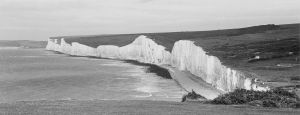
Now the coffee is finished, so I turn left and walk towards the cliff rising up at the end of the front, and soon feel the extra pressure in my lungs as the gradient is attacked. But it feels so good to have my feet planted on the chalk again, and every step higher reveals more of the Downs around, so that the effort is unnoticed. I feel gloriously loved and alive, surrounded by warmth and life. Over the summit and one of the quintessential English landscape vistas is revealed; the delicious waveform, green icing on pure white cake, of the chalk cliffs between Cuckmere Haven and Belle Tout, the Seven Sisters. Walking on the springy turf along the top and heading east towards Hope Gap the sunlight bounces back with increasing intensity from the sheer chalk walls. The low winter light saturates the colours and confounds sight; it could be June if not for the patches of icy drift in the fields beside the track. Snow dusts the green flanks of the Downs flowing inland from the Sisters towards Lewes, but a summer-like haze rims the unbroken deep blue sky. Hands feel the chill of the frozen air, but the face glows in the heat of the sun. I walk among spirits from the past yet feel invincibly alive. I know that the clean white face of the chalk wall in front of me means that this landscape I love for its permanence is disappearing in front of my eyes, slice after slice slipping into the insatiable sea. I feel ineradicable sadness at the terrible toll life is taking on those close to me, and huge happiness at the love I feel directed at me.

Earlier, from the keep of Lewes Castle, the Downs, perspective distorted as the sinuous shapes melded into a tenuous mist, took on the aspect of vast and distant mountain ranges; clothed as they were in snow, the pallid border of a land of ghosts. Now, here by the crumbling cliff edge of Seaford Head the air is joyously clear and fresh, giving life with every breath taken in. I can smell spring coming; drawing near, bearing hope in a blaze of new growth. The grass is fresh green, newly created this moment. Less than two hundred feet above the sea, but the feeling is of walking in the sky, feet barely touching the dense and resilient turf. Forward motion is effortless, more akin to flying than walking. Nothing is what it seems, everything is something else. Negative is positive, cold is warm, permanence never lasts, the ephemeral is eternal.

On the way back down to Seaford, heading for the railway station, the path passes through a golf course, empty of golfers and full of dogs walking with their companions, and joins a suburban road, the villas lining the north side basking in the glory of this divine afternoon as the sun sinks westward. In the quiet I feel an immense peace flowing through me; I feel at home, and long to return to a home filled with love. I know my father and brother and mother were happy in this place, if only for a while, and I think some of their happiness still lingers. We survive as memories held in store by those who outlive us; the more a person is loved, the more a person cares for others, the stronger the memory and the stronger the survival once that person leaves.

This life is searing pain and fierce joy, this life is utterly meaningless and profoundly meaningful. What we think is important means nothing, the things we overlook mean everything. A glance from a loved one means more than any money or status or success; to have the ability to be transfixed by the beauty around us is to be in receipt of a priceless gift. Don’t waste these things; they can be gone before we realise. Enjoy every second, both bad and good, because it’s all we have.

Blue remembered hills, May 2010

Nostalgia: 1. A bittersweet longing for things, persons, or situations of the past; 
2. The condition of being homesick; homesickness.
From the Greek nostos, a return home.
 
I tend to view the world through a haze of nostalgia, a longing for a past that possibly never existed, but the word has negative connotations; a hankering to return to a past (imagined or real) where life was easy, an inability to cope with modern life, old people parroting “It was better in my day”. These probably all apply to me in some measure, but even when younger I would have exquisite pangs of nostalgia for times I never actually experienced; imagined experiences would become, in effect, memories to be relived in times of unhappiness. It has been comprehensively proved that what we think of as memories of real events are in fact deeply flawed, often almost wholly fictitious; there is actually little difference between memory, fantasy and fact, ‘real’ and ‘unreal’…

Deep summer, July or August, 1964. On Ashdown Forest the heat envelops me like a duvet, an audible as well as tactile heat, a sussuration of gorse popping, heather rustling, grasshoppers chirping, grass snakes flicking themselves into the scrub. Middy, dressed dapperly as ever in a light grey suit, is getting the picnic out of the car. Middy is otherwise Mr.Tisdall, family friend, taking me, my sister and brother and mother on a day out in his lovely Citroen DS21 with the pale leather seats and air suspension. Middy is called Middy because, as a youngster, apparently I was unable to articulate Mr. Tisdall and the nearest I could get was ‘Middy Tiddy’. Cute, eh? I am very fond of him, as we three children (my sister Sara, brother Chris and me) are growing up not knowing a father, and this kindly, soft-spoken, smiling, smartly-dressed, white-haired man is the nearest we will get to a paternal figure. 

 
I have these warm and fuzzy, glowing and golden memories of this man, who actually was my father (not that I knew that then, but that’s another story), but they are at least partly wishful thinking, and certainly composite versions of real events. Other than this, my main childhood memories are of places and things rather than people; we grew up in a single-parent household, my mother (I now realise with the benefit of hindsight, not granted then to this oblivious child) suffering from deep depression and loneliness, which inevitably osmosed into Sara, Chris and me. I had some friends at primary school but didn’t get close, and what remains clear in memory now are things like waiting for the bus home from school at Eridge Forstal and seeing cotton-wool plumes of smoke from the trains in the valley below, winding south to Brighton or Eastbourne through the enfolding Weald; or hearing the ghostly call of the cuckoo from the woods that used to exist close to our house in Crowborough (destroyed in about 1964 and replaced with housing); or the sandstone outcrops in the playground at Eridge County Primary, smooth, cool, grey-green and very hard (great for racing Dinky cars down, but not so great when you fall over and crack your head).
 
Looking back, forty-five or fifty years on, a deep warmth and sense of home suffuses these images; they have become fixed permanently, as much a part of me as my hands or feet. Without these reference points I am adrift, a non-person. I suppose they fix my mind in a time before things started to go wrong; 1965 is the cut-off point. This was the last year I saw the man who was my father (I was, many years later, to find out why this was so) which, despite the fact I only knew him as a ‘family friend’, affected me deeply, and it was also the year I passed the 11-plus (the only one to do so in my small village school) which doomed me to the horrors of The Skinners’ School. At Eridge I was a medium-sized fish in a very small pond; at Skinners’ I was a very scared whitebait in a frightening ocean, and completely out of my depth. I started in a top stream (due to an apparently excellent 11-plus performance) but rapidly dropped to the bottom stream by the third year. I hated the teachers, I hated the ugly buildings, I hated my fellow pupils (the term ‘schoolmates’ is inappropriate in this case) but most of all I hated myself for failing so totally. Out of school I retreated into imagination; the buses became a means of escape. True, they took me to school, but they also took me away from it, and further into the Sussex countryside, green and comforting. Idiotic as it may sound, the sight and sound of an old apple-green-and-cream Southdown double-decker at a vintage vehicle rally can actually provoke an emotional response from me. I still love travelling by bus (or train) now; you enter a state of grace where no-one can make demands on you. You are in a sort of limbo, a powerless, transitory state, where nothing is expected of you, so you can’t fail to deliver.
 
These melancholy musings have been sparked by a trip back to Sussex to visit sisters Jo, Maggie and Ros. The familiar journey, the familiar Downs, the familiar roads and towns and villages bring ancient memories to the fore again. A circle is on its way to being completed; finding the siblings who share my father, my DNA, my old home after all that time has passed is a blessing. It seems strange that during those years I would have many times have passed within feet of them, but had no knowledge that my flesh and blood lived within touching distance. Memories of loved ones passed, my mother, father and brother Michael, have become more poignant with this knowledge; from this vantage point and with the comprehension that age brings I realise how they all suffered for what happened in that long-ago time, that different country.
 
What I am trying to say is that nostalgia is, I think, more than just a shallow hankering for the past; it has inspired much English artistic endeavour, from Gray and AE Housman through Ralph Vaughan Williams and JRR Tolkien to Pink Floyd and Nick Drake. I am, always have been, drawn to any expression of that peculiarly English elegiac, wistful melancholy; it strikes a chord very deep inside. I still haven’t worked out exactly what these feelings mean, why seeing a picture of my father for the first time in 40 years should provoke the same confused senses of loss and homecoming as listening to Pink Floyd’s ‘Remember a Day’ or RVW’s ‘The Lark Ascending’, or reading Richard Jefferies’ ‘The Story of My Heart’. It is as if, in the absence of close and loving relationships in my childhood, those unrequited feelings were given to the familiar things around me; the hills, the paths, the trees, the buses that took me away from home into contact with all these loved things. It feels as if, with my father and mother and brother gone, the feelings have somehow become one with these places and things and have achieved a sort of immortality.
 
I struggle to convey these feelings in language; listen to ‘The Lark Ascending’ or ‘Fantasia on a Theme from Thomas Tallis’, or try and look at Paul Nash’s final Sunflower paintings, or visit Berwick Church (Sussex, not Northumberland) to see Duncan Grant’s murals and you might have some idea what I am talking about. The term ‘nostalgia’ for me encompasses, as well as a strong affinity with the past, a great desire for roots, for home; a deep, almost spiritual link with landscape; and an aching sense of loss of childhood, of loved ones and of loved places. This all probably makes me weak-willed, backward-looking and lacking in intellectual strength, but so be it; after more than 50 years perhaps it’s time to accept who this person is and what drives him, and work with it rather than trying to bury it.

Made in Sussex, June 2010

I love chalk hills, and in particular the South Downs in Sussex, where I was born and raised. In truth, although the Downs were a magical but vaguely ominous background presence in my youth, I never actually walked on their ancient trackways until I was about 18 or 19. All my youthful explorations on foot, by bike and bus were in the central part of Sussex called the Weald (stretching east into Kent and west to the Hampshire border, but these boyhood explorations described a much smaller orbit). ‘Weald’ comes from Old English word meaning ‘forest’.

Before going too much further, a bit of geology needs be explained. Many millions of years ago, during the Jurassic and Cretaceous geological periods, the bit of the world that is now the South-East of England was under warm, shallow tropical seas. Huge rivers flowing into this sea deposited vast amounts of eroded sands, silts and muds in successive layers over the aeons, to create a sort of colossal club sandwich of sandstones, clays and limestones. The top slice of white bread is the chalk (in Lower, Middle and Upper layers), created out of the decomposed calcium skeletons of untold billions of microscopic algae that swarmed in these warm seas about 100-65 million years ago. By this time there was little deposition of other sediments, so these chalk strata are pretty much pure calcium carbonate, blinding white when exposed. Anyway, about 45 million years ago Africa and India were on their way back North and, not looking where they were going, collided with Europe and Asia, pushing up the Himalaya, the Alps and other mountain ranges of Eurasia as they did so. However, much more importantly, our club sandwich was also bent out of shape, being pushed up out of the sea into a huge elongated dome (which geologists call an anticline). The layers cracked (rock not generally being known for its flexibility) and over the following millions of years the highest parts of the misshapen sandwich eroded down from these fissures, eventually leaving the only the edges of the upper strata. This is why the landscape south of London follows a mirror-image pattern towards the English Channel; North Downs (chalk), clays, greensand ridge, more clays, a central high block of the oldest sandstone, yet more clays, a smaller greensand strip, even more clays and finally back to chalk again at the South Downs, where the strata curve down in a sincline under the Channel to rise again in Northern France. The Weald is the tumbled ruins of sandstone and clay between the cleanly sheared-off edges of the chalk strata. Viewed from directly overhead, imagine a huge eye; the skin of the eyelids representing the chalk ridges curving to join at the east and west ends, the white and iris the greensand and clays, the pupil the central hard sandstone of the High Weald.

Where the chalk is pure in geological make-up and in form, the Weald is chaotic; the multiplicity of underlying rock creates a distinctive, varied landscape of successive ridges and valleys, much still heavily wooded even today. Where the Downs offer smooth flowing ridges and uninterrupted vistas, the Weald is intimate with one valley being insulated from the next; constant change occurs around each corner and over every hill. The area is further divided into Low and High Wealds, which nomenclature is self-explanatory. I grew up in a place called Crowborough on the edge of Ashdown Forest, a former royal hunting ground halfway between London and the Channel coast, on the central high sandstone outcrop which forms the High Weald. From the highest point here I could see over the lesser southward rise of the greensand to the mighty South Downs, and, turning through 180 degrees, the line of the much higher northern greensand ridge with the North Downs behind; I would look up and wonder how high above me the chalk dome would have been 45 million years ago, before the endless years of erosion removed it to leave the northern and southern ridges as its only remnants. Even now, the outer slopes of the chalk (known as the dip) preserve the shallow angle of the sides of the original bowl and you can follow these angles in imagination to a convergence high above north Sussex. In contrast, the slopes of the chalk facing into the bowl (the scarp) are abrupt, almost perpendicular in parts, retaining the memory of how the rock was ruptured in geological upheaval.

From the sandy, dry High Weald you drop by steep lanes, incised deeply into the stone through millennia of use, to the wetter, clayey Low Weald. This is an ancient area, rich with thousands of years of human use. The South Downs are also ancient, but their atmosphere is of civilisations gone to dust, the picked bones of a landscape, frozen and dessicated history; history in the Weald still lives, layered over millennia to create a sort of social geology where the story of how people lived can be easily read, and still has influence on how people live there today. These two areas, Downs and Weald, were the poles of my world, and both contain their own polarities; the Downs cleansing, uplifting, open yet enigmatic, the Weald enveloping, comforting, homely yet secretive. Visually, the South Downs are easily described; a green, smooth, flowing ridge, billowing like a heavy swell, an imperceptibly breaking wave ever threatening to engulf the fields and farms, towns and villages of inland Sussex. The Weald is much more complex and convoluted; hammer ponds in hushed shaded valleys, white-cowled oasts peeping over burnt-orange-tile-hung farmhouses, shingled church spires on distant ridges, greeny-grey fissured and sculpted sandstone outcrops, heather-glowing high heath, water-flowing subterranean ghylls. If you know Alfred Bestall’s illustrations in the Rupert Bear annuals you will have some idea of what large areas of the Weald look like; the landscapes in his illustrations were apparently based on the area in which he lived in North Wales, but the pictorial elements of dense woods, gentle hills and narrow valleys, successive waves of lush green foliage turning to purple with distance, the occasional church spire clearing the treetops, give a good approximation of this archetypal English landscape.

Many things that shaped the area are now memory; iron is no longer smelted as it was from at least Roman times until the Industrial Revolution, although deep in woods or incorporated into a garden as a huge water feature can be found hammer ponds, streams damned to provide water power for forge hammers. As a child on the bus to school in spring I would see men, balanced on high stilts, stringing the tall hop-poles ready for that summer’s crop, creating enormous cat’s cradles in the fields lining the road all the way to Eridge; much of the Low Weald in Kent was given over to hops until the sixties. Hop growing is hugely reduced nowadays, but the distinctive white-cowled, circular oasts where the flowers were dried, now mostly private homes, are bequeathed to today’s landscape as reminders. Riding my bike through the lanes around Crowborough, past Redgate Mill and up to Rotherfield on its eminence, or down the main Uckfield road, the radio masts towering to my right, to Herons Ghyll before diving down and steeply up again to Fairwarp, I slowly became aware of all the history soaked into the landscape around me. Ruined mills, breached pond bays, coppices grown wild through disuse, railway cuttings through which only ghost trains now passed, even bits of Roman road still with original ironstone-slag surfaces; all these could be found in bosky valleys and rioting woodlands, and I sought them out, inhaling deeply the atmosphere of all-returns-to-earth rot, deep greeny-brown and humus-perfumed. The smell of decay means life is recycling itself, taking on new forms, although I doubt I thought of it this way as a youth; I just loved the deliciously melancholic and abandoned feel of places like these.

In many ways, the Weald hasn’t suffered as badly from the ravages of modern life as some areas, hasn’t lost its soul completely; you can still, if you want to, explore the maze of lanes away from the main roads and find green peace. There are no motorways and few fast roads passing through, although the formerly serpentine A26 between my childhood home and school at Eridge has been straightened, a vandal’s knife slash through the old hop-fields and orchards, so that Mr Middle-Manager in his BMW or Audi can get to work in Tunbridge Wells without having to bother about slowing down; discarded to either side remain those interesting squiggly bits of road, tarmac oxbow lakes, silted with grass and gently returning to nature. If you like, accompany me on the Southern train from London Bridge to Uckfield which seems to retreat into the past as it heads southwards. After Oxted and the tunnel through the Greensand ridge you are in the Weald and the stations get smaller; Edenbridge is somewhere, Hever is on the way to somewhere else, Cowden is seemingly nowhere. We alight at Eridge (where once trains connected to take you all over Sussex and Kent before a certain Dr Beeching decided nobody needed a choice of transport; travel anywhere you like as long as it’s by car), have a pint at the Huntsman’s and then follow one of those squiggly bits I mentioned, up what used to be called Snake Hill, towards Eridge Forstal.

At the top, stand at the bus stop for a few minutes (ignoring for the moment BMW Man, HGV Man and Van Man hurtling past) and look southwards. Nothing out of the ordinary, but all the parts coalesce into a whole of stunning beauty; the hillside drops away in front of you, Hamsell Manor snug in the valley below, and the landscape gradually rises again, intricately detailed; woods, small fields, hedges, crinkle-crankle lanes, tile-hung farmhouses, swelling up towards the spire of St Denys at Rotherfield in the blue distance. I have to think myself deeply fortunate to have been intimately linked to this bit of landscape as a child; my primary school is two hundred yards or so up the lane opposite, and my friends (Steve Woodger and Robin Downes, Clive and Jimmy; wonder where you are now) lived in the village or on the country estates spread in front of us; their parents still worked at that time (the early sixties) mostly for the Abergavenny or Soames families at Eridge Park or Hamsell Manor, as gamekeepers, farm workers, domestic staff. I would sometimes venture back here at weekends and explore the estates, timidly, with Steve or Robin leading; fording streams, hanging off branches, hiding-and-seeking amidst hot, dry, dusty, hayfevery wheatfields.

Laying aside reverie, we can walk up the Forstal, noise diminishing away from the main road, past Eridge County Primary. My old school is now a private house; the family’s children have free rein amongst the former playground’s trees and rocks. Over Hamsell Wood Farm we can see further south and east towards Saxonbury Hill, folly tower breaking mysteriously out of the cloud bank of woods. Down now along lanes, then farm tracks to cross the railway and stream by Harrison’s Rocks, huge versions of the child-size sandstone outcrops in the old playground. Through the constantly changing interplay of elements (up and down, light and dark, water and rock, wood and field, lane and path) we can find our way west through Mott’s Mill to Friar’s Gate where we enter Ashdown Forest; steeply from here a road leads, past the house where Richard Jefferies lived for a while, to Crowborough. Turning southwards, and upwards, through the ancient coppice of Five Hundred Acre Wood (as 100 Aker Wood it appears in AA Milne’s Winnie-the-Pooh books; the author lived in Hartfield a couple of miles away) the track eventually bursts out on to high, open heathland, vast prospects opening out all around. We can now follow the Roman road through the heather and ling and gorse, navigating by the Scots pines huddling in clumps all over the Forest; we are aiming for Camp Hill Clump in its small Iron Age earthwork. It looks a long way, but it’s easy, fast, exhilarating walking over this high and dry heathland; in summer we will kick up dust and make the gorse crackle as we pass.

The radio masts at King’s Standing, another minatory presence from childhood (aircraft warning lights glowing red at night, hanging in the black), are gone now, but just down the road Duddleswell Tea Rooms still looks exactly as it did all those years ago; set back off the road behind a close-cut lawn, white-rendered, gravel path to the central door, symmetry in the black-framed bay windows either side. If this was a hushed, gently breezy, hazily sunny, warm Saturday afternoon in the late sixties we could sit and wait here, eyes half-closed against the light, for a number 119 bus back to Crowborough, but Southdown double-deckers haven’t run past here for many years, so we’ll walk south-easterly away from the road and down off the edge of the Forest. Up, down and around tortuous lanes we come to High Hurstwood; this tiny, scattered community could once summon enough people (housewives with shopping baskets, smartly-dressed pensioners going to meet their friends in Uckfield, teenagers with pocket money to spend in the record shop) to make a sizeable crowd waiting at The Maypole, and fill to capacity the big Leyland single-decker that ventured down the deeply-sunken lane three times a week.

We can complete the circle, on what’s become a sort of circumnavigation of a childhood, and walk on down to the railway viaduct by old mill ponds, then by lanes up and up through Burnt Oak and Stone Cross, each just a farm and a junction of old lanes with little Dairylea triangles of grass and those lovely Sussex road signs to show you the way to Crowborough. We enter the town past Alderbrook Estate (no prefabs now) and Luxford Cottage where my brother Michael used to live. We turn left down Blackness Road, past Luxford Manor; Michael’s father-in-law was the gardener there until the early seventies (prog rock fans may be interested to know that Van Der Graaf Generator recorded their 1971 album Pawn Hearts here). Turning right down wooded paths, then round the back of the old brickworks we emerge next to Crowborough station. This is actually in Jarvis Brook, a previously separate settlement in the valley equidistant between the town and Rotherfield (in fact the station when opened was named after Rotherfield, as this was then far more important than Crowborough, which only grew after the railway arrived). My first job after leaving school was here in a small print firm in a tiny building, Lexden Lodge, hard by the railway embankment; the start of adult life after an, in many ways, idyllic childhood.

When I started writing this I didn’t really have an idea where it was going to end up, but it turned from topography to autobiography. For me the two are very closely linked; it’s unthinkable to describe any part of my life without reference to the landscape it was lived in. A large part of me was constructed in these places; they made me what I am.

Maybe it’s time to go home.

Loss, September 5th 2014

Autosave-File vom d-lab2/3 der AgfaPhoto GmbH

The endless river flows. Since the end of April the elderflowers have come, been gathered and gone. Now at the start of September the elder is laden with sprays of berries, heavy droplets the colour of congealing blood. Seven years ago today we were married at Dorchester registry office, with Archie as our page-dog, and our wedding night was spent here at Yalbury Cottage. Much has changed in those seven years (a mirror broken, maybe); Yalbury has new owners, the registry office is no longer where it was, Archie is dead.

Heidi is dead.

As we sat, Alfie and I, outside the old registry office, me lost in thought, Alf laying quiet, a dragonfly performed aerobatics around us, living its brief life in joy. It seemed to be inquisitive, flying around us in tight loops, and the fancy entered my mind that it might be her, in a transitional state before her next life. Maybe she was checking I was alright, or trying to let me know that she was. Researching dragonflies later, it seems that the Southern Hawker is very inquisitive, often behaving the way I had noticed. The fancy remains, though; I have often felt in the months since her death that she was near me, or was ordering events in some way to guide me. It is likely that other people suffering bereavements experience similar things; but, again, who knows where a soul goes after death?

Prosaic happenings become charged with meaning when living with loss; the smell and sound of a bonfire, ashes dancing skywards; watching the summer slowly die. Emotion is on a hair-trigger; an exhausting see-saw of quietude and sudden grief. Sometimes the heart desires rest, to slip from the edge and be free. Sometimes the mind desires solace in thought free from pain.

There is a train, moving slowly, gently rocking, the comforting smell of dusty upholstery. There is a destination, soon to be reached. There is sunlight, summer-warm and autumn-gold. It is blown in through the open window on the breeze that swoops down from the hills through which we are travelling. There is a sense of waking after sleep, refreshed. Alf is with me, but otherwise the carriage is empty. The land also appears empty, but there is a peace, and there is a sense of presence, many presences, not visible.

There is a station, and the train stops. We alight. The train leaves and we stand on the platform in the settling quiet. A woman with a mass of golden curls sits on the bench at the other end of the platform. She stands and walks towards us, a small white dog trotting beside. No words are spoken, but I know she feels no pain; sickness no longer torments her body. We clasp hands, turn and walk together out of the station, along a white track by the endless river. Others join us as we walk. My mother and father walk together; she has no heartache now, he has no guilt. Michael walks also with us, along with his father; he no longer feels burning self-hatred and the pain of rejection. They also are reconciled.

The white track slopes up, into the smooth green hills. We walk towards the skyline, and suddenly the sea is below us. Sheer chalk cliffs stretch away to either side, dazzling white. Behind us the land is green and gold. Before us there is the blue between sea and sky, between the old life and the next. Our stride doesn’t falter; we slip from the edge to be free.