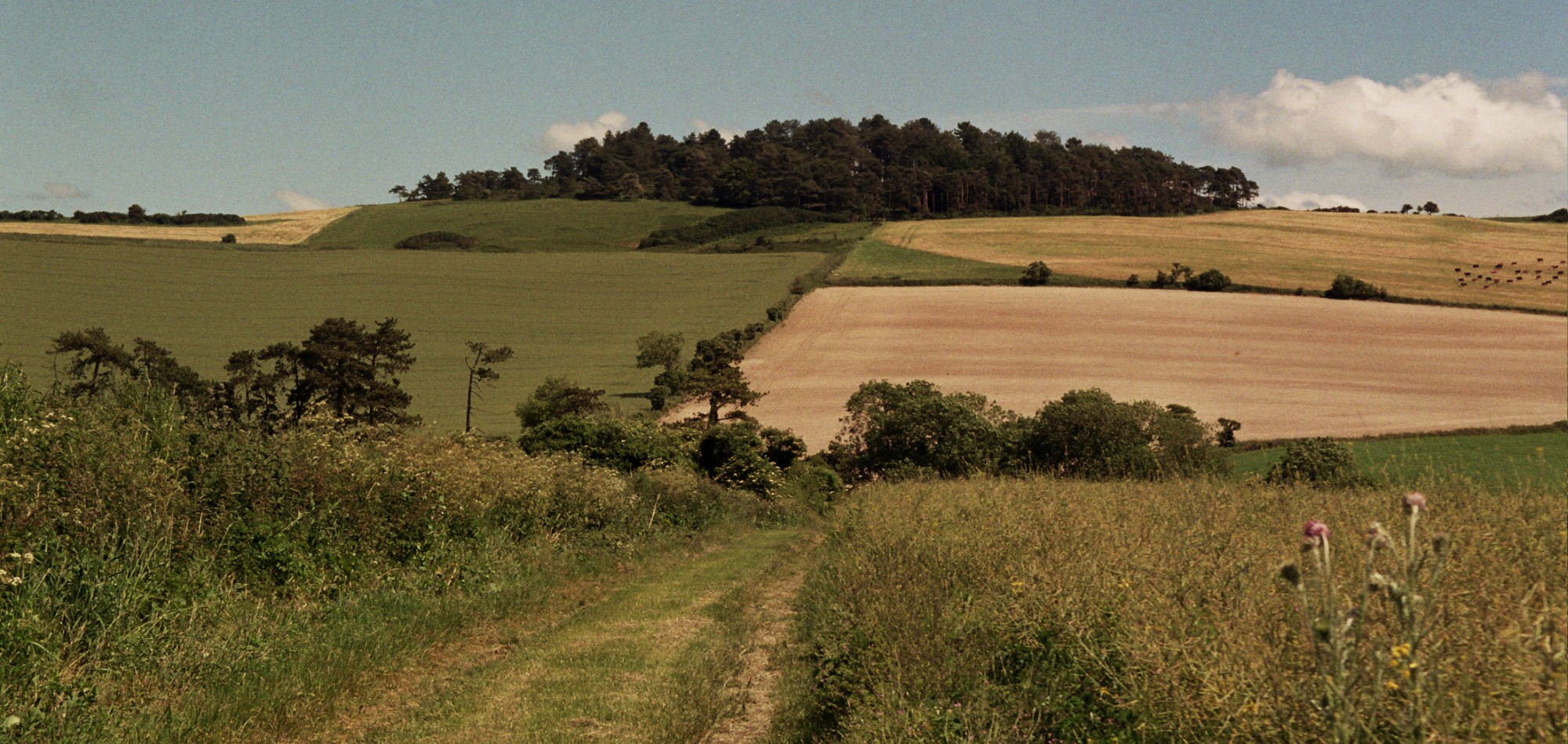
Walking through a wheat field in Wiltshire two weeks after visiting a damp Dorset, and the crop here is drying, at last. The rain has lessened in the interval (if not ceased entirely) and this evening is warm and bright. Alf and I are camping in the VeeDub, at a campsite near to Stonehenge, and we are hurrying to the Boot Inn at Berwick St James to assuage thirst and hunger after a long drive. The evening is not only warm and bright, it is perfectly, heartbreakingly glorious, the sort of evening we English think our Summer evenings should be, but rarely are. The perfection continues as we enter the small inn, me sweating and Alf panting with the sudden heat inside; ‘Is it OK to bring my dog in?’ I ask. ‘Absolutely’ the barlady says with a smile, tactfully ignoring the fact that in my eagerness to get in I hadn’t noticed the several dogs already milling around inside, rendering my question pointless, if not idiotic. People smile at Alf as he says hello to fellow canines; ‘Oh, how sweeeet; what sort is he?’. I order a pint of Wadworths 6X and a plate of sausage and mash, then we go outside to sit at a table in the evening sunlight. The beer is perfect, possibly the best pint of 6X I’ve tasted. The other customers sitting outside are perfectly friendly (mainly down to Alf, it must be said; everyone we meet wants to know about him).
The temperature is also perfect now, as Sun slips slowly down behind the row of perfectly English thatched and beamed cottages on the other side of the village street. The occasional tractor roars up or down the road; farmers will be working all hours to gather in the harvest now that the weather is finally giving some quarter. Our dinner appears; two large locally produced pork sausages for me, one for Alf. It is perfectly delicious, my taste buds tingling at the taste of fresh, properly produced meat (usually vegetarian at home, I love to eat proper meat and fish when I get the chance). The second pint of 6X is as good as the first, and for the first time in, well, a very long time, I feel content, free of sorrow, free of worry. I know this will only last for this stolen weekend, but it will have to do.
With the problems of hunger and thirst solved, and my head gently buzzing from two pints of decent beer, it seems a good idea to make the most of this magic evening and walk back to the camper the long way round. So we stroll southwards out of the village, to where the road bends sharp left to cross the little River Till. There is a junction with a track running along the west bank of the river here, and a small pool has formed on the downstream side of the bridge.
Alf paddles in, as usual; the water is running fast under the bridge, but this shallow pool is calm and I let him enjoy his immersion. Now turning east with the road, and then carrying on straight where the road curves south again we start to climb gently along a wide track towards Druids Head Wood on the ridge ahead. The track follows the subtle curves of strip lynchets on the hillside; they in turn follow the contours of the coombe as it melds into the main flow of the ridge. At a crossing of ways, between the small wood and the farm, we turn due north along a hard metalled track following the ridge.
The temperature now is cooler, but the air is laden with the memory of warmth, and the light is still golden. It diminishes and changes, as we walk fast along the track, to copper, then bronze and finally to molten iron as Sun starts to drip over the edge of the world. Beech clumps punctuating the downs to the west are ships anchored on the chalky swell of the Plain in the slow darkness. At the next intersection of tracks an owl hoots from a patch of woodland. We are now heading to meet the main road to the West, the old Harroway, so at the next crossways, between another farm and another small wood (this landscape has a quality of rhythmic repetition that I like) we turn south through fields, rapeseed pods whispering dryly, and down into the village of Winterbourne Stoke. Just past the church a gate opens on to a field containing four huge sycamores; a causeway passes them and runs south back to Berwick by the river, but we turn right to cross it by a footbridge (the plash of rising fish seeming loud in the cool air) and back to the campsite.
It’s good to be back on Salisbury Plain after a gap of several years and I feel excitement at the thought of exploring further tomorrow. I like the ominous edge the landscape possesses; the juxtaposition of the serene curves of the chalk bedrock and the quiet beauty of the valley villages with the ugly, angular evidence of military occupation and intensive farming that confronts you at intervals. It is a landscape that can seem very bleak, even under full sunlight; try walking the track from Gore Cross through the ghost village of Imber to Warminster when the military next open up the ranges and you will know what I mean. However, the open nature of the landscape and its sometimes disconcerting emptiness also gives rise to its ability to calm the mind, to let it free to contemplate higher matters. Even without the litter of monuments to the ancient dead, the Plain would still be a place where the mind regards eternity. Alf and I sleep well.
In the morning, Alf is impatient to be out and about, so in early sunlight we walk back through Winterbourne Stoke and cross the Harroway (not yet, this early, transformed into its screaming, psychotic alter-ego, the A303) to follow the track towards Shrewton. Willow pollards mark the course of the River Till as it runs down from Salisbury Plain. The ‘Winterbourne’ in the village name tells you the truth about this stream, which is not technically a river, nor originally named Till. It was only given this name after a Victorian map maker decided that the stream simply called locally ‘Winterbourne’ must sensibly, as it rose near the village of Tilshead, have given its name to this place, the Head of the Till; an understandable leap of logic, as this is not-uncommon source of place naming (for example, Exmouth is actually a place situated at the mouth of, and so named after, the river Exe), but unfortunately in this case Tilshead is a derivation of the Early English ‘Theodwulf’s hide’. Pedantry aside, it is a warm, sunny morning in late July, and normally at this time of year the stream would be non-existent, its course marked only by a snake of lusher greenery squirming through the fields, for the Till is a type of watercourse found in chalk and some limestone areas known as a winterbourne. These streams, as the name pretty well explains, only normally run in winter and early spring, after the autumn and winter rains have raised the water table in the chalk bedrock. But, as this past year’s weather patterns have been strangely inverted (an unusually dry autumn and winter followed by the wettest spring and summer for a century), many chalk streams had been dry right through the last winter, only to gush forth from May onwards as week on week of torrential rainfall soaked into the aquifers.
So the Till on this beautiful, soon to be hot, morning is full, glinting between the pollards, and in fact actually overflowing its shallow bed and flooding some of the fields it runs through. The view is from the top of one of an assemblage of barrows (prehistoric burial mounds) erected approximately 3500 years ago on the lower slope of High Down, west of the upper reaches of the Till (the back-formed name is still useful to distinguish it from the several other winterbournes in this chalk country). Surrounding the barrows is a much later, probably medieval, earth bank called The Coniger; ‘coney’ is an old word for rabbit, and the name indicates the barrows were utilised as warrens later in their career. True to his terrier lineage, Alf chases the coneys around the Coniger, but never catches one. About a mile north-west, on the other side of the valley, is Fore Down, with its own collection of barrows looking down over the water. Directly west, about two miles just over the crest of the distant ridge, is the Winterbourne Stoke Crossroads group; a Neolithic long barrow, aligned on the midwinter sunset, at the head of a train of large Bronze Age round barrows taking the same alignment, at the crossing of east-to-west and north-to-south trackways (still important in their present-day tarmac disguises). And a mile further west is Stonehenge, invisible from here but the magnetic centre of the enormous landscape composition in chalk, sky and water that is Salisbury Plain.
Proximity to water seems to be a factor in the siting of these places; sources of good water would obviously be extremely important to early settlers in this high-and-dry landscape. The chalk is an extremely efficient filter and storage system, and springs flowing from it supply crystal clear, safely drinkable water. Some would be subject to seasonal interruptions in flow (the winterbournes), so watercourses with a year-round flow would be even more valuable, and revered as givers of life. So, echoing on a larger scale these small barrow groups overlooking the tiny Till/Winterbourne, important sites like the Stonehenge and Avebury complexes are connected to, respectively, the Avon and Kennet, both permanently flowing rivers.
But all these sites, large and small, are also linked with the sky and the underworld, acting as a conduit between these two states beyond life, and mortal life, as represented by earth and water. In describing these places it’s difficult not to use phrases like ‘ceremonial landscape’ or ‘ancient religion’; from this time, looking back to that time without the help of written history, we can have no certain idea of the impulses and states of mind that caused people to build places like Stonehenge or Avebury or the dense scattering of barrows (singly, in groups or alignments) and other, even more enigmatic, earthworks over the chalk hills of Southern England. However, when you actually stand at one of these places an atmosphere of sanctity still seems to cling to them (even, just, to poor, mistreated Stonehenge with its bleak car park, hot-dog stands and high-security fencing).
I think that, probably, those people in the past had the same need for spiritual comfort as we do, the same desire to make sense of, and impose order on, a harsh and random Nature. And so they raised the earth and stones under their feet to create beautiful monuments to their dead, to mark and stand sentry over water sources, to follow the spinning courses of seasons and heavenly bodies. These monuments seem to have been created following certain principles involving lines of sight, a harmonious relationship with the surrounding landscape, relationships to other monuments and links to water sources; what believers in the Age of Aquarius would call geomancy, and the Chinese refer to as feng-shui. There’s an awful lot of drivel spouted by neo-pagans about a posited pre-Christian, nature-worshipping, female-centric ‘ancient religion’, most of it as laughable as the idiocies of Christianity, Islam and the other fairy tales we insist on creating for ourselves; ley lines, standing stone phalli penetrating blind springs (water flowing underground), nodes of geomantic energy, a Neolithic National Grid of spiritual power with Glastonbury Tor, Avebury and Stonehenge as immense generators. It’s all too laughably self-serving.
But, but…. and but (and this would be my own personal fairy tale, not to be imposed on anyone else by violence or missionary zeal), when I walk an ancient track from one ancient monument to another, and see how our forefathers worked with the landscape they lived in to create something beautiful that seems to say something about our position in creation and so gave that landscape a spiritual dimension that is felt in the heart as much as seen by the eyes, I believe that the landscape, the earth walked upon, is numinous and contains a spirit of place that our own tiny spirits respond to. I might even be tempted to call this spirit ‘God’, except that what I don’t believe is that this spirit or force regards us at all, other than as simply another component of the natural world; it probably would not have intelligence, as we would understand that term, and it certainly wouldn’t be there to ‘look after’ us, however many stones we raised or prayers we uttered. The spirit is rock, and wind, and seasons slowly cycling, and slow erosion, and tectonic movement, and water flowing underground, same as it ever was. Its utter disregard of me, and all of us, is immensely beautiful, and immensely comforting in its boundless creativity. Maybe James Lovelock’s concept of Gaia is nearer the mark.
So now it’s out in the open; I’m an unreconstructed hippy, a neo-pagan flower-child, a scion of the New Age of Atlantis. Whatever, that sense of deep spiritual contact with a semi-sentient landscape is why I walk; every step is a pilgrimage following thousand of others, mixing a few of my atoms with a few remaining from my predecessors, and with those of the earth under my feet. Eventually all my atoms will become part of the landscape, like one of the billions of tiny shellfish whose deaths over aeons slowly created the chalk that my feet feel so at home on.
 White tracks, green hills