High summer in rural Dorset and the sound and smell and feel of water is everywhere. Driving to Cerne Abbas we descend the steep lane from Piddletrenthide, swept downhill from the ridge like a canoe shooting rapids. Arrived, and hurriedly unloading the car outside the guest house (unsuccessfully trying to dodge huge raindrops), the culverted stream thunders under the pavement; water bubbles through cobblestones from the flooded cellar of the New Inn opposite.
Taking Alf for a short post-travel leg-stretch proves foolish; as soon as we set foot on unpaved paths we sink in ooze, liquid mud splashing with every step. Vegetation, in rampant rain-fuelled overgrowth, slaps against us, soaking those parts not yet wet as a result of the pouring rain and the waterlogged soil. We trudge a few hundred yards along the path below the Giant’s feet, then admit defeat and retreat back to the guest house to remove sopping clothes, and to towel a drenched dog.
Later, after dinner at the sodden-but-still-open New Inn, in the gloaming, dried-out dog and I walk again around the village. The rain has reduced to a gentle drizzle, but the sound of the several streams joining here to form the River Cerne still fills the air, water rushing, trickling, dripping. Heavy clouds press down on the surrounding hills, roofing over the valley and sealing in the sound. It feels safe here; at any time this valley has a quality of time in suspension, an atmosphere of solitude and peace, but the huge, soft grey duvet slowly settling down intensifies this feeling. The air smells like the sea.
In the morning, rain ceased and sun glowing, we go to St Augustine’s Well in the churchyard, walking first along Long Lane out of the village, then back round through spongy fields. The spring here is the reason Cerne Abbas exists (probably has existed in some form for thousands of years) as a settlement; rainwater percolating through the chalk hills to the north meets a water-resistant layer of clay, to escape through a small fault in the chalk as this beautiful upwell of clear water. In a normal late June the well water would normally be still and stagnant, low in its basin, but this sodden summer it is overflowing and running fast, clear and cold, perfectly filtered by miles of chalk and perfectly drinkable. This spring of pure water encouraged our ancestors to settle by it, and they very likely revered it as a source of life; it still bears a mythology of healing and fertility (many of the sites of ancient reverence in the chalklands of southern England were linked to sources of water; for example, the Avebury complex to the rising of the River Kennet, or Poor Lot barrow cemetery and the Nine Stones circle in South Dorset to the springs feeding the South Winterbourne). In 987 CE, an abbey was founded on this already ancient sacred site; the bright early morning sun brings the humps and holes that are, mostly, all that remains of the abbey into sharp relief as Alf and I tramp wetly through the just-mown grass, glistening with its freight of moisture. The green curve of Giant Hill soars above the trees, but He cannot be seen. The air is viscous with the past.
Rain unexpectedly holds off for the rest of the day, and in the late afternoon, while Heidi rests, my right-hand-dog and I set off on another exploration, passing through the abbey ruins again and this time taking the path that ascends, at a shallow angle, the south-eastern flank of Giant Hill (really a mile-long promontory thrust out at ninety degrees from the main chalk ridge ahead of us). The evening is gently warm, breezy; pale sun illuminates the opposite wall of Yelcombe Bottom at intervals as we climb the hawthorn-bordered track. Patches of light from a celestial mirror-ball, texture of sheep-trods suddenly thrown in relief. At the top, we contour round the summit of the hill to reach the western side, passing more humps and holes, these much older; Iron Age people settled on this high, dry, easily defended belvedere. Maybe they also garnered some comfort from the fearsome presence of the Giant a few yards away, but invisible on the steep nose of the promontory. I like to think of them using the path we had just ascended to fetch water from the sacred spring down below. The air is soft and clear, beech clumps on the Sydling ridge sharp and looming near.
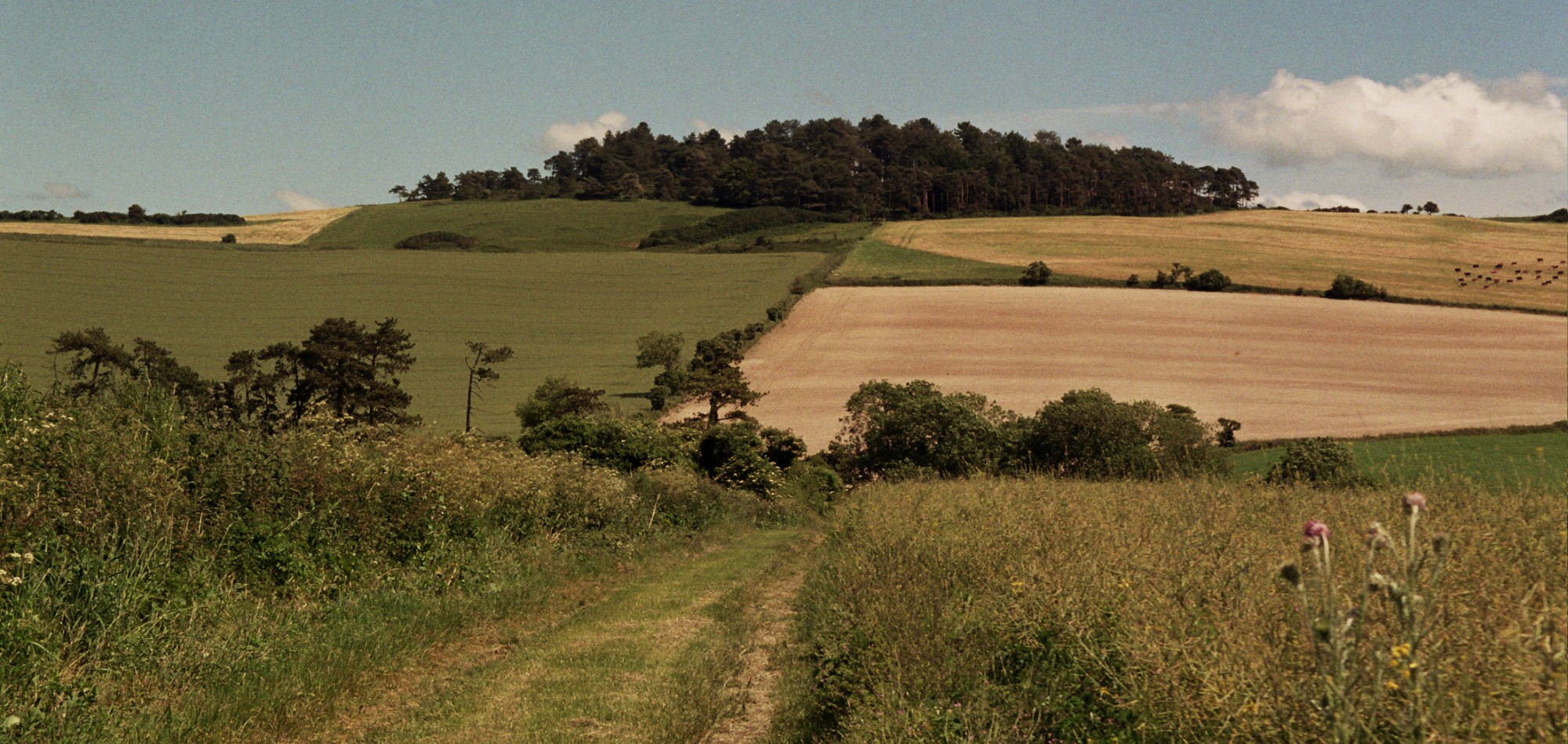
A gate opens on to a field of wheat, where some Moses has cleft a path between the stalks, through a sea that shimmers silky grey-and-green as the wind stirs it to waves. It should be glowing dull gold by now, the plump ears fed by rain in spring drying and bleaching in the heat of summer. A surfeit of rain and a shortfall of sun means that the breeze soughs through plants swollen with moisture, but still green behind the ears. Water equals life, but sometimes there is too much, even on these swiftly-draining chalk hills. Farmers pray for dry weather to harvest. They can do little else; for all the technological and chemical help available to them they are as powerless in the face of weather as the first Neolithic farmers on these hills, scratching the thin topsoil to sow emmer wheat and trusting to the offerings they had made to the land to guarantee a harvest, as the spring gushed below. We push on, parting the waves, towards the dark clump of beeches and oaks marking the old ridge track hugging the horizon ahead, but before reaching it turn down left, through the wooded hillside towards Minterne Parva, with, above it, Minterne House cradled near the head of the Cerne valley, the twin heights of Dogbury Hill and High Stoy looming, mysterious in green, on either side. Between them, the col at Dogbury Gate affords a Palmeresque vision of the Blackmore Vale beyond, pale gold in sudden sunlight.
Nestled back down in the valley, we walk along the lane from Minterne Parva and reach the river again, a smaller stream here, near to its beginnings. Alf paddles and drinks noisily, as is his custom, looking up at me with water dribbling from the fur on his muzzle as if to say ‘That’s better…’. I just enjoy the sound of the Cerne bubbling through the little culvert under the lane, under the trees, the endlessly dancing facets flashing the shaded sunlight in my eyes. The evening is warm, pale copper and peaceful under the sun. Thirsts slaked, we walk on, under trees, over the main road as the evening bus to Sherborne burbles past (not an earthy brown Bedford, sadly; Bere Regis & District buses only run now in memory).
Across the road the trees overhead change from oak to beech, forming woodland on the slope of High Cank to our left, and bordering the park of Up Cerne Manor to our right (cricketers practising on the sward backlit by evening sun, almost a caricature of essential Englishness). My footfalls on the tarmac fall into a syncopated rhythm with the regular bass of the beeches passing by as we descend the hill; Alf’s freeform scampering (up, down, across, back to where he just started) could be Jeff Moris Tepper soloing over the top. It rocks.
We do the floppy boot stomp, down into the ground, and find ourselves in the valley of the Cerne’s tributary, at Upcerne (or Up Cerne; no one seems to mind which). We halt at the centre (if it’s possible for a place so small to have a centre), where the stream crosses the lane and a smaller lane forks off northwards to become a track and then a path gradually ascending to Telegraph Hill on the great chalk ridge that falls into Blackmore Vale. The stream is spreading across the road from its shallow bed. We stand by Not The Bus Shelter to take water again (Alf from the stream, me from my flask) and the thirty years since the last bus disappear. The water still flows, same as it ever was. This place is still quiet, after all those years, and instils quietness in me. Quietness is not an absence of sound, it is water flowing, leaves rustling, birds talking; it is sounds that soothe the soul. Noise is any sound, however low in volume, that destroys the soul; it is the hungry growl of traffic in the distance, the inane beeping of computers, the emotionally and intellectually bankrupt drivelling of daytime TV. I want to enter further in to the quietness, up the valley, but we are already overdue for supper, so we will return tomorrow.
In the morning, we retrace the straight path through the wheat and pass the squat, seemingly organic, bulk of Up Cerne Manor, lichen-grey against chalkhill-green. The rain has returned, but only as showers out of the grey above, refreshing rather than drenching. Taking the left fork we walk beside the stream running fast and clear in its channel, spreading still over the surface of the lane. Vegetation drifts in the crystal water, freshest-possible green; seemingly Ophelia could drift past at any moment. The clouds lower, lambent with concealed sunlight as we pass Great Pond, the source of the stream; but the quietness issues from further ahead, so we continue beyond the tarmac onto rutted chalk as the way ascends gently. Dark woods line the crest of the eastward ridge; that to the west is bare. We progress along the track towards the head of the valley, also wooded, as the two walls converge.
A hare stands in the way ahead, only moving slightly into the field beside as we pass him, slowly now. Alf doesn’t chase the elfin creature, he seems aware of its magical significance. I look around after we pass and the hare is swallowed in the crop. The path takes a right hand curve to approach the valley’s end by a shallow spiral. A buzzard glides over into the woods on the ridge ahead. The path empties into an open field sloping at first gently, then steeply, up towards the ridge. I feel a tension, a slight buzzing in the head, in this natural amphitheatre, a not-unpleasant claustrophobia and a sense of immanence; the tension breaks as a deer runs diagonally up the hillside into the woods, following the buzzard’s path. This landscape retains the memory of water in its shape, as well as a vast reservoir within its physical mass; glacial meltwater seems to flow over me, scouring the valley’s smooth shape as I watch. Turning, I look back down the valley and the claustrophobia disappears to be replaced by a sense of freedom. We start to march fast back towards Cerne Abbas, light of foot and paw; I have a feeling of being pushed from behind by a vast wave, a hydraulic ram filling the trough of the valley, and of being cooled by water falling from above, gently.
The land teaches us of life, but we no longer understand its language.
 White tracks, green hills