Deep summer, July or August, 1964. On Ashdown Forest the heat envelops me like a duvet, an audible as well as tactile heat, a sussuration of gorse popping, heather rustling, grasshoppers chirping, grass snakes flicking themselves into the scrub. Middy, dressed dapperly as ever in a light grey suit, is getting the picnic out of the car. Middy is otherwise Mr.Tisdall, family friend, taking me, my sister and brother and mother on a day out in his lovely Citroen DS21 with the pale leather seats and air suspension. Middy is called Middy because, as a youngster, apparently I was unable to articulate Mr. Tisdall and the nearest I could get was ‘Middy Tiddy’. Cute, eh? I am very fond of him, as we three children (my sister Sara, brother Chris and me) are growing up not knowing a father, and this kindly, soft-spoken, smiling, smartly-dressed, white-haired man is the nearest we will get to a paternal figure.
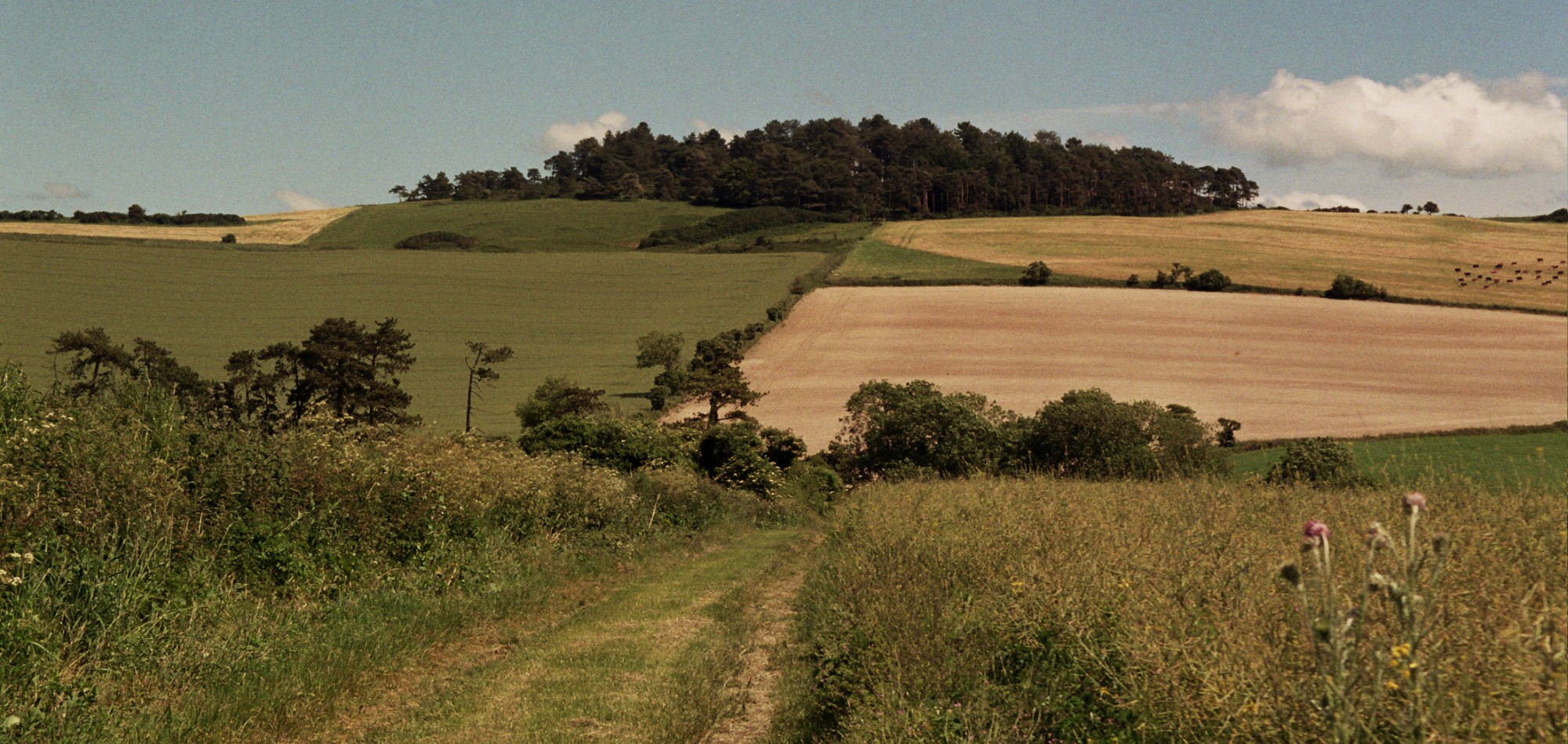
Blue remembered hills, May 2010
Leave a reply
Nostalgia: 1. A bittersweet longing for things, persons, or situations of the past;
2. The condition of being homesick; homesickness.
From the Greek nostos, a return home.
I tend to view the world through a haze of nostalgia, a longing for a past that possibly never existed, but the word has negative connotations; a hankering to return to a past (imagined or real) where life was easy, an inability to cope with modern life, old people parroting “It was better in my day”. These probably all apply to me in some measure, but even when younger I would have exquisite pangs of nostalgia for times I never actually experienced; imagined experiences would become, in effect, memories to be relived in times of unhappiness. It has been comprehensively proved that what we think of as memories of real events are in fact deeply flawed, often almost wholly fictitious; there is actually little difference between memory, fantasy and fact, ‘real’ and ‘unreal’…
I have these warm and fuzzy, glowing and golden memories of this man, who actually was my father (not that I knew that then, but that’s another story), but they are at least partly wishful thinking, and certainly composite versions of real events. Other than this, my main childhood memories are of places and things rather than people; we grew up in a single-parent household, my mother (I now realise with the benefit of hindsight, not granted then to this oblivious child) suffering from deep depression and loneliness, which inevitably osmosed into Sara, Chris and me. I had some friends at primary school but didn’t get close, and what remains clear in memory now are things like waiting for the bus home from school at Eridge Forstal and seeing cotton-wool plumes of smoke from the trains in the valley below, winding south to Brighton or Eastbourne through the enfolding Weald; or hearing the ghostly call of the cuckoo from the woods that used to exist close to our house in Crowborough (destroyed in about 1964 and replaced with housing); or the sandstone outcrops in the playground at Eridge County Primary, smooth, cool, grey-green and very hard (great for racing Dinky cars down, but not so great when you fall over and crack your head).
Looking back, forty-five or fifty years on, a deep warmth and sense of home suffuses these images; they have become fixed permanently, as much a part of me as my hands or feet. Without these reference points I am adrift, a non-person. I suppose they fix my mind in a time before things started to go wrong; 1965 is the cut-off point. This was the last year I saw the man who was my father (I was, many years later, to find out why this was so) which, despite the fact I only knew him as a ‘family friend’, affected me deeply, and it was also the year I passed the 11-plus (the only one to do so in my small village school) which doomed me to the horrors of The Skinners’ School. At Eridge I was a medium-sized fish in a very small pond; at Skinners’ I was a very scared whitebait in a frightening ocean, and completely out of my depth. I started in a top stream (due to an apparently excellent 11-plus performance) but rapidly dropped to the bottom stream by the third year. I hated the teachers, I hated the ugly buildings, I hated my fellow pupils (the term ‘schoolmates’ is inappropriate in this case) but most of all I hated myself for failing so totally. Out of school I retreated into imagination; the buses became a means of escape. True, they took me to school, but they also took me away from it, and further into the Sussex countryside, green and comforting. Idiotic as it may sound, the sight and sound of an old apple-green-and-cream Southdown double-decker at a vintage vehicle rally can actually provoke an emotional response from me. I still love travelling by bus (or train) now; you enter a state of grace where no-one can make demands on you. You are in a sort of limbo, a powerless, transitory state, where nothing is expected of you, so you can’t fail to deliver.
These melancholy musings have been sparked by a trip back to Sussex to visit sisters Jo, Maggie and Ros. The familiar journey, the familiar Downs, the familiar roads and towns and villages bring ancient memories to the fore again. A circle is on its way to being completed; finding the siblings who share my father, my DNA, my old home after all that time has passed is a blessing. It seems strange that during those years I would have many times have passed within feet of them, but had no knowledge that my flesh and blood lived within touching distance. Memories of loved ones passed, my mother, father and brother Michael, have become more poignant with this knowledge; from this vantage point and with the comprehension that age brings I realise how they all suffered for what happened in that long-ago time, that different country.
What I am trying to say is that nostalgia is, I think, more than just a shallow hankering for the past; it has inspired much English artistic endeavour, from Gray and AE Housman through Ralph Vaughan Williams and JRR Tolkien to Pink Floyd and Nick Drake. I am, always have been, drawn to any expression of that peculiarly English elegiac, wistful melancholy; it strikes a chord very deep inside. I still haven’t worked out exactly what these feelings mean, why seeing a picture of my father for the first time in 40 years should provoke the same confused senses of loss and homecoming as listening to Pink Floyd’s ‘Remember a Day’ or RVW’s ‘The Lark Ascending’, or reading Richard Jefferies’ ‘The Story of My Heart’. It is as if, in the absence of close and loving relationships in my childhood, those unrequited feelings were given to the familiar things around me; the hills, the paths, the trees, the buses that took me away from home into contact with all these loved things. It feels as if, with my father and mother and brother gone, the feelings have somehow become one with these places and things and have achieved a sort of immortality.
I struggle to convey these feelings in language; listen to ‘The Lark Ascending’ or ‘Fantasia on a Theme from Thomas Tallis’, or try and look at Paul Nash’s final Sunflower paintings, or visit Berwick Church (Sussex, not Northumberland) to see Duncan Grant’s murals and you might have some idea what I am talking about. The term ‘nostalgia’ for me encompasses, as well as a strong affinity with the past, a great desire for roots, for home; a deep, almost spiritual link with landscape; and an aching sense of loss of childhood, of loved ones and of loved places. This all probably makes me weak-willed, backward-looking and lacking in intellectual strength, but so be it; after more than 50 years perhaps it’s time to accept who this person is and what drives him, and work with it rather than trying to bury it.
 White tracks, green hills